As Vietnam strengthens its presence as a manufacturing base in global supply chains, 2025 saw a series of decisions to establish free trade zones (FTZs) and to put their legal foundations in place across major cities. In 2026, these moves are entering the operational stage, marking the start of full-scale implementation.
- Da Nang and Hai Phong. The establishment of their FTZs was decided during 2025, and they are now in the stage of developing the zones and attracting investors.
- Ho Chi Minh City. A National Assembly resolution in December 2025 put the legal foundation for establishment in place, and procedures toward the city’s establishment decision are underway.
- In December 2025, the Prime Minister gave in-principle approval to the Ministry of Finance’s proposal on piloting FTZs.
As of July 2026, there is still no overarching law or decree governing FTZs in general, so they are being piloted on the basis of city-specific National Assembly resolutions.
Drawing on primary sources such as National Assembly resolutions, this article explains the institutional differences between the conventional SEZ and the FTZ, the developments in the three leading cities (their specific investment incentives and the current state of infrastructure), and the special rules on the use of foreign currency, a point of high practical interest.
1. A Shift in Institutional Approach. How Economic Zones (SEZs) and Free Trade Zones (FTZs) Differ
The economic zone (commonly the special economic zone, or SEZ), which has long been a principal gateway for foreign investment into Vietnam, and the newly created FTZ differ in character on two fronts, their development objectives and their legal status for customs and clearance purposes.
(1) Economic Zones (SEZs). Lifting the domestic economy across a broad area
This model concentrates diverse industries within a large designated area, with the main aims of infrastructure development, job creation, and driving the economy of the wider region.
SEZs are managed under the decree on industrial zones (IZs) and SEZs, and, in principle, the general domestic legal framework applies. An SEZ as a whole is not automatically granted special customs treatment. Only where a non-tariff area is established within it does customs relief apply, and only to that part.
Under the Law on Import and Export Duties, a non-tariff area is defined as an economic area that lies within Vietnamese territory, has defined geographic boundaries, is separated from the outside by solid barriers, and secures the conditions for customs inspection, supervision, and control. Trade in goods with areas outside it is treated as import and export. As a result, no customs duty is imposed and clearance procedures are simplified across the whole sequence of bringing in, storing, sorting, assembling, processing, and re-exporting imported goods.
(2) FTZs. Pursuing a high-value-added economy by optimizing international logistics at specific points
This model confines the zone to the hinterland of a major port or international airport.
The interior of an FTZ is made up of various functional zones for production, logistics, commercial services, and the like, which differ from one FTZ to another. Among these functional zones, those that meet the statutory conditions for a non-tariff area receive non-tariff treatment under customs inspection and supervision.
The non-tariff area mechanism itself can also be set up within an existing SEZ, so this structure is not unique to FTZs. What distinguishes an FTZ is that it is designed by National Assembly resolution as a pilot zone that places the operation of a non-tariff area at its core while applying special measures on corporate income tax, land, labor, and foreign currency in an integrated manner. Each city’s resolution positions the FTZ as a zone with defined geographic boundaries, established to pilot exceptionally advantageous, breakthrough special mechanisms.
2. The Front Line of FTZ Development in the Three Major Cities
(1) Central Vietnam. Da Nang Free Trade Zone (Da Nang FTZ). The country’s pioneering first case
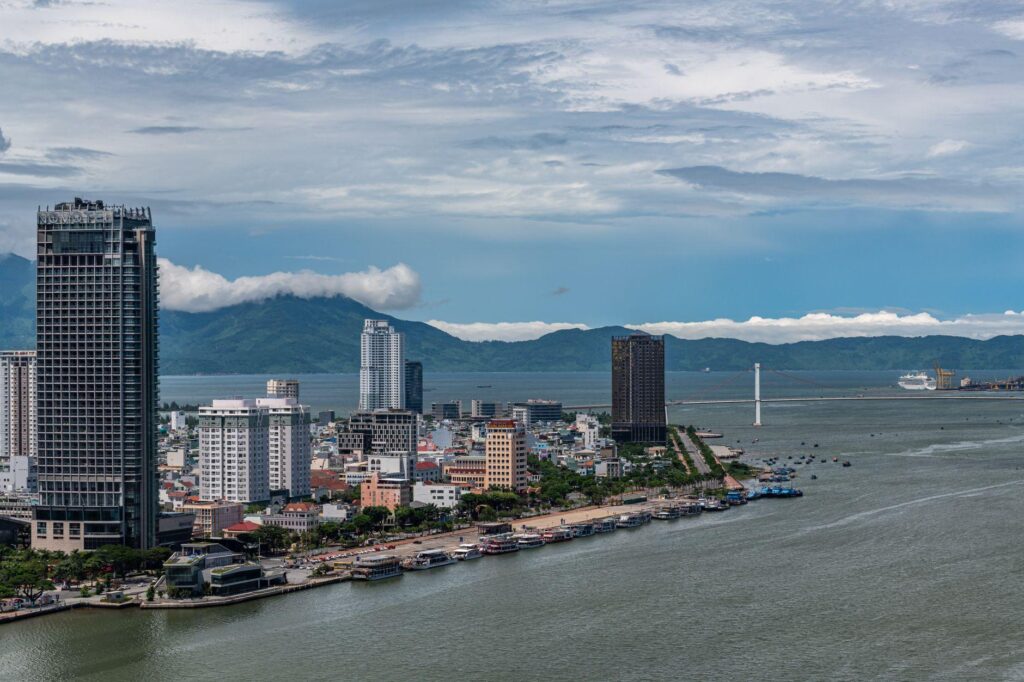
The Da Nang FTZ is the first FTZ established in Vietnam. Resolution No. 136 provided for the establishment of an FTZ linked to Lien Chieu Port, and it was established by a Prime Minister’s decision based on that resolution. Seven non-contiguous lots (with a total area of about 1,881 hectares) are laid out around Lien Chieu Port and the former Hoa Vang district, housing functional zones for production, logistics, commerce, services, digital technology industries, innovation, and more. Management is handled on a one-stop basis by the Da Nang High-Tech Park and Industrial Zones Authority (DSEZA), which centrally processes matters such as the issuance of investment registration certificates, work permits, and certificates of origin (C/O).
(i) Priority industries
Semiconductors, AI and digital technology, high-tech manufacturing, modern logistics using digital technology, fintech, and the like.
(ii) Main investment incentives
- For corporate income tax (standard rate 20%),
- new investments in priority fields (high technology and strategic technology, innovation centers and R&D, high-tech supporting industries, clean-energy vehicles, rail and aviation equipment including MRO, wind-power equipment and renewable-energy infrastructure, and international freight transshipment and logistics facilities) receive a preferential rate of 10% for 30 years.
- Other fields receive 10% for 15 years.
- In either case, within the period over which this preferential rate applies (30 or 15 years), the first 4 years are tax-exempt and the following 9 years carry a 50% reduction in tax payable (applied on top of the 30-year or 15-year preference).
- Personal income tax for experts, scientists, and highly skilled personnel working in the FTZ is reduced by 50% for 10 years.
- For investment projects within the FTZ, other than projects on land for housing construction and for commercial and service use, land rent and rent for water-surface land are exempt for the entire lease term.
- When establishing a corporation (economic organization) within the FTZ, foreign investors are not required to first hold an investment project and obtain and adjust an investment registration certificate (IRC) before establishment (Resolution 136, Article 13, Clause 5(b), a provision to the same effect as Hai Phong’s). Subsequently, from March 1, 2026, obtaining the enterprise registration certificate (ERC) first also became possible for foreign direct investment outside FTZ areas through the amendment of the Investment Law, so the FTZ anticipated that amendment.
(iii) Current state and outlook of infrastructure
- On June 13, 2026, investment registration certificates were issued for three infrastructure development projects, Lot 2 (about 75 ha), Lot 3 (about 500 ha), and part of Lot 4 (about 335 ha), totaling about 910 ha with total investment of over VND 15,025 billion (approx. USD 590 million).
- Da Nang plans to build a database of strategic investors by the third quarter of 2026.
- For surrounding infrastructure, the consortium for the container terminal project at Lien Chieu deep-water port (Hateco Group, APM Terminals, and others) was finalized in March 2026, with the first phase targeted to begin operation in early 2029.
- Development is proceeding by leveraging connections with Da Nang International Airport and the East-West Economic Corridor (EWEC) that links to Laos and Thailand, and the city has indicated that it expects the FTZ to contribute 8 to 9% of gross regional domestic product (GRDP) by 2030.
(2) Northern Vietnam. Hai Phong Free Trade Zone (Hai Phong FTZ). A large zone in the north’s biggest port city
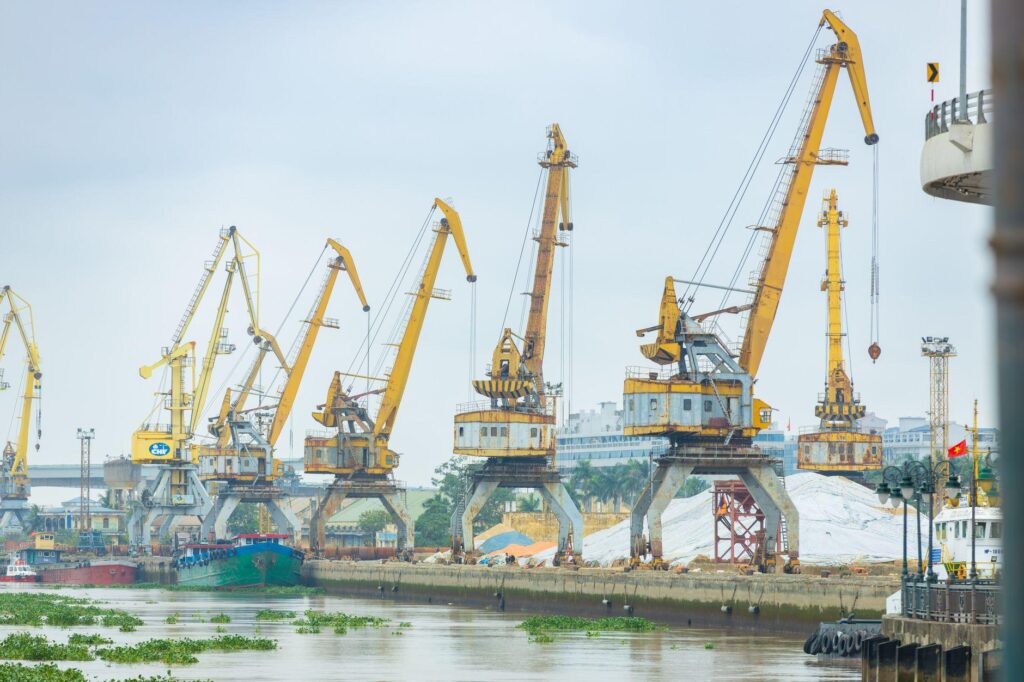
The establishment of the Hai Phong FTZ was provided for by Resolution No. 226. Linked with the Dinh Vu-Cat Hai SEZ and the Southern Coastal SEZ, the city People’s Committee was granted authority over its establishment, expansion, and boundary adjustment. On that basis, it was established by Hai Phong City People’s Committee Decision No. 4068. The pilot period for the FTZ’s special rules is 10 years.
The total area is about 6,292 ha, made up of three non-contiguous zones (Southern Coastal, about 2,923 ha; the Dinh Vu area, about 1,077 ha; and the Cat Hai area, about 2,292 ha). The Dinh Vu area includes part of the site of the Deep C Industrial Zone (over 840 ha), which is home to many Japanese companies. Among these functional zones, those meeting the statutory conditions for a non-tariff area are subject to non-tariff tax treatment.
(i) Priority industries
Semiconductors (integrated circuits, chips, semiconductor materials, and the like), biotechnology, new materials, automation, high-tech supporting industries, logistics centers, exhibition and commercial centers, and more.
(ii) Main investment incentives
- For new and expansion investments in priority fields (the fields listed in Item 1(a) above), a preferential corporate income tax rate of 10% applies for 30 years. The first 4 years are tax-exempt, the following 9 years carry a 50% reduction, and after the preferential period the rate is 15%. For non-priority fields, 10% applies for 15 years, with the same conditions for exemption, reduction, and post-period rate.
- Except for land for housing and for commercial and service use, land rent and water-surface rent are exempt for the entire lease term.
- Personal income tax for experts, scientists, and highly skilled personnel working in the FTZ is reduced by 50% for 10 years.
- Normally, to establish a corporation in Vietnam a foreign investor must first obtain an investment registration certificate (IRC) for the investment project, but within the FTZ this step is unnecessary and a corporation can be established through the same procedure as domestic investors (enterprise registration) alone (Resolution 226, Article 10, Clause 1(b)). This exception is not limited to priority fields for attraction; it applies to foreign investors establishing a corporation within the FTZ generally (the list of priority fields relates to the separate special investment procedure under Clause 1(a) of the same article). Note that screening of sectors with market-access restrictions for foreign investment continues to apply, and where a project is carried out after the corporation is established, investment registration procedures under the law are followed.
- The Hai Phong Economic Zone Authority (HEZA), an agency directly under the city People’s Committee, manages the FTZ directly and centrally processes matters such as issuing certificates of origin (C/O), granting business licenses without requiring referral to other agencies, and issuing work permits without requiring job-posting procedures.
(iii) Current state and outlook of infrastructure
- As the first project, LG Innotek’s semiconductor package substrate plant (total investment of USD 1 billion) is underway toward a construction start in 2026.
- In July 2026, development of the zone is accelerating, including the start of construction of Tien Lang 1 Industrial Zone (about 596 ha) in the Southern Coastal SEZ.
- Expansion is underway at Lach Huyen International Port, the largest deep-water port in the north, and in July 2026 the conclusion of a joint-venture contract for the development of four container berths by PSA Vietnam and others (the first two berths scheduled to enter service in 2028) was announced.
(3) Southern Vietnam. Ho Chi Minh City Free Trade Zone (HCMC FTZ). A commerce and logistics FTZ linked to a mega-port
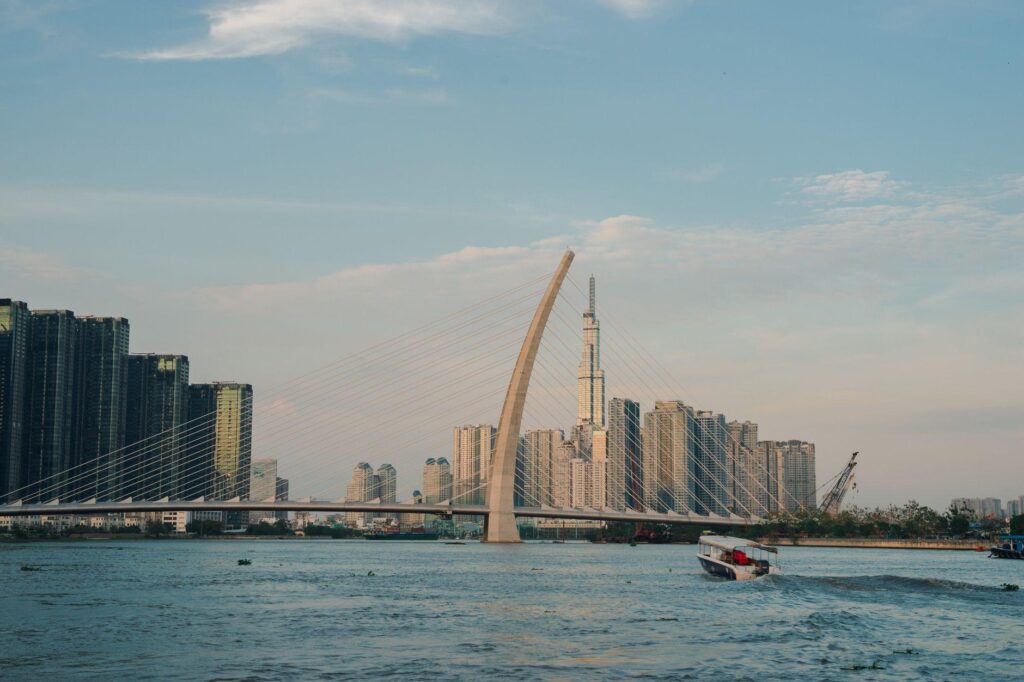
The legal foundation for establishing the Ho Chi Minh City FTZ was set when Resolution No. 260 inserted Article 7a (Ho Chi Minh City Free Trade Zone) into Resolution No. 98. The authority to decide on establishment, expansion, and boundary adjustment rests with the city People’s Committee, linked with the Cai Mep Ha port area. As of July 2026, the city has not yet issued an establishment decision. Procedures toward establishment are underway, including the city’s creation of an FTZ implementation steering committee in June 2026 (the city’s initial targets were an establishment decision in the first quarter of 2026 and selection of strategic investors in the third quarter).
The core area is expected to be about 3,800 ha in the Cai Mep Ha area, which connects directly to the Cai Mep-Thi Vai cluster, one of Vietnam’s largest deep-water port groups (following the administrative reorganization of July 2025, this area was incorporated from the former Ba Ria-Vung Tau province into Ho Chi Minh City). In the future, expansion into Can Gio, An Binh, and Bau Bang (all within the current Ho Chi Minh City area) is envisioned, and a management model is planned in which several geographically separate areas make up a single FTZ. The interior of each area is further divided into functional zones for production, logistics, commercial services, and the like. The construction of the Can Gio International Transshipment Port (an investment of over VND 50 trillion, approx. USD 2 billion) is positioned as a priority project for attracting strategic investors.
(i) Priority industries
Smart logistics, international commerce and transshipment trade, cross-border e-commerce, high-tech manufacturing, international conferences and exhibitions (MICE), and more.
(ii) Main investment incentives
- For new investment projects in priority fields (semiconductors, AI, R&D centers, new materials and semiconductor materials, high-tech supporting industries, energy and digital infrastructure, large structures related to oil and gas, wind-power equipment, and the like), a preferential corporate income tax rate of 10% applies for 20 years. The first 4 years are tax-exempt, and the following 9 years carry a 50% reduction.
- Personal income tax for experts, scientists, and highly skilled personnel working in the FTZ is reduced by 50% for 10 years.
- Except for commercial housing construction projects, the chairperson of the city People’s Committee may decide on the allocation and lease of land without auction or tender.
- For conformity certification, for goods that have already been published, and for goods whose conformity assessment results are mutually recognized under international treaties to which Vietnam is a party, specialized inspection at import and export is waived.
- Normally, to establish a corporation in Vietnam a foreign investor must first obtain an investment registration certificate (IRC), but within the FTZ this step is unnecessary and a corporation can be established through the same procedure as domestic investors (enterprise registration) alone.
Note that an International Financial Center (IFC) has separately been established in Ho Chi Minh City and Da Nang, and the law on a specialized court for the International Financial Center took effect on January 1, 2026, but these are systems separate from the FTZ.
3. A Key Practical Point. Special Rules and Restrictions on the Use of Foreign Currency within FTZs
In Vietnam, the Ordinance on Foreign Exchange Control in principle prohibits residents and non-residents within Vietnamese territory from conducting transactions, payments, displays, advertising, quotations, price-setting, and price entries in contracts in foreign currency (except for permitted exceptions set by the State Bank of Vietnam). For FTZs, express exceptions to this principle have been provided in National Assembly resolutions.
(1) Permitted acts (special measures)
The National Assembly resolutions on all three FTZs allow enterprises that are headquartered within an FTZ and engaged in production and business activities, in transactions supplying goods and services to one another within the FTZ, to display, quote, set, and enter prices in contracts in foreign currency, and to make and receive payments in foreign currency by bank transfer.
(2) Applicable restrictions
- The exceptions apply only to transactions for the supply of goods and services within the FTZ between enterprises headquartered within the FTZ. For transactions with domestic Vietnamese enterprises or individuals outside the FTZ, the principle of Vietnamese dong denomination applies as before.
- Settlement must be by bank transfer. Cash settlement is not permitted.
- General laws such as the Anti-Money Laundering Law continue to apply to transactions within the FTZ.
Conclusion. A New Phase for Vietnam’s Investment Environment
Taking the full-scale launch in the three cities in 2026 as a starting point, the Vietnamese government has set long-term goals to develop 6 to 8 FTZs nationwide by 2030 and 8 to 10 of international standard by 2045, and to generate 15 to 20% of GDP from these zones.
An FTZ is a framework for attracting investment that combines the customs treatment and simplified clearance provided by the non-tariff area mechanism, incentives such as corporate income tax breaks, and special rules on the use of foreign currency. It is a development that signals the changing investment environment in Vietnam. The detailed regulations to be promulgated by each city and the direction of their operation going forward will be worth watching.
TMI Consulting Vietnam, as a group company of TMI Associates, provides consulting on foreign direct investment (FDI), cross-border M&A, investment scheme structuring, and overseas expansion. For inquiries on overseas expansion, M&A, and investment strategy, please feel free to contact TMI Consulting Vietnam (info@tmiglobalconsulting.co.jp).
References
- National Assembly Resolution No. 136/2024/QH15 (adopted June 26, 2024), full text
- National Assembly Resolution No. 226/2025/QH15 (adopted June 27, 2025; effective July 1, 2025)
- National Assembly Resolution No. 259/2025/QH15 (adopted December 11, 2025; effective December 12, 2025)
- National Assembly Resolution No. 260/2025/QH15 (adopted December 11, 2025; effective December 12, 2025)
- National Assembly Resolution No. 98/2023/QH15 (adopted June 24, 2023), full text
- Prime Minister’s Decision No. 1142/QD-TTg (June 13, 2025)
- Hai Phong City People’s Committee Decision No. 4068/QD-UBND (October 13, 2025)
- Law on Import and Export Duties No. 107/2016/QH13
- Ordinance on Foreign Exchange Control (No. 28/2005/PL-UBTVQH11, as amended by No. 06/2013/UBTVQH13)
- Vietnam Government e-Newspaper, “Prime Minister gives in-principle approval to the free trade zone pilot proposal” (December 5, 2025)